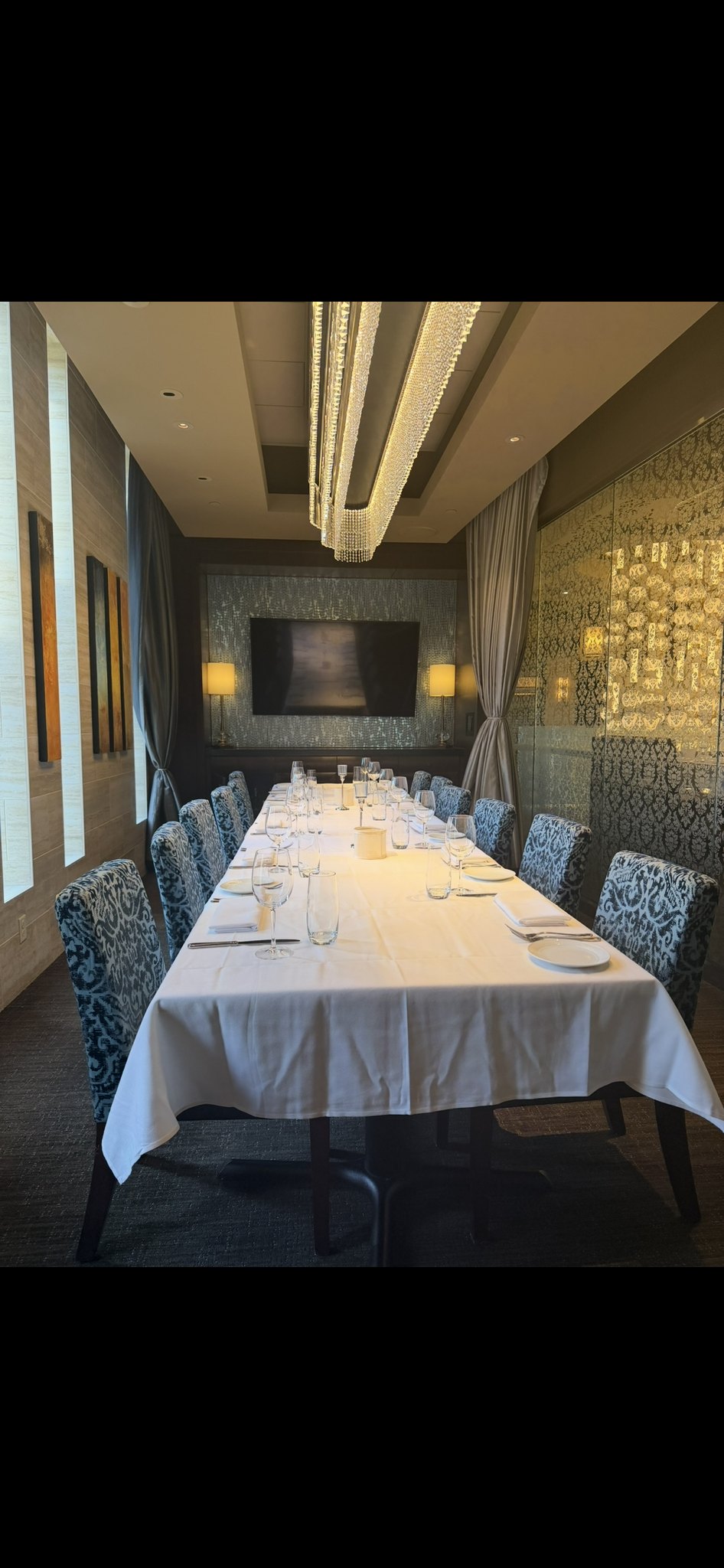
A restaurant dinner meeting looks easy on paper. Twenty-five people, a private room, a few slides and a speaker. Then you walk in and find a room the size of a large living room, a long table down the middle and a wall full of wine bottles where the screen was supposed to go.
I have set up AV in a lot of restaurants around Nashville and Middle Tennessee. The gear is rarely the hard part. Space is. Here is how I think about equipment for a restaurant meeting or client dinner, and what I would ask before you book.
Start with the room, not the gear list
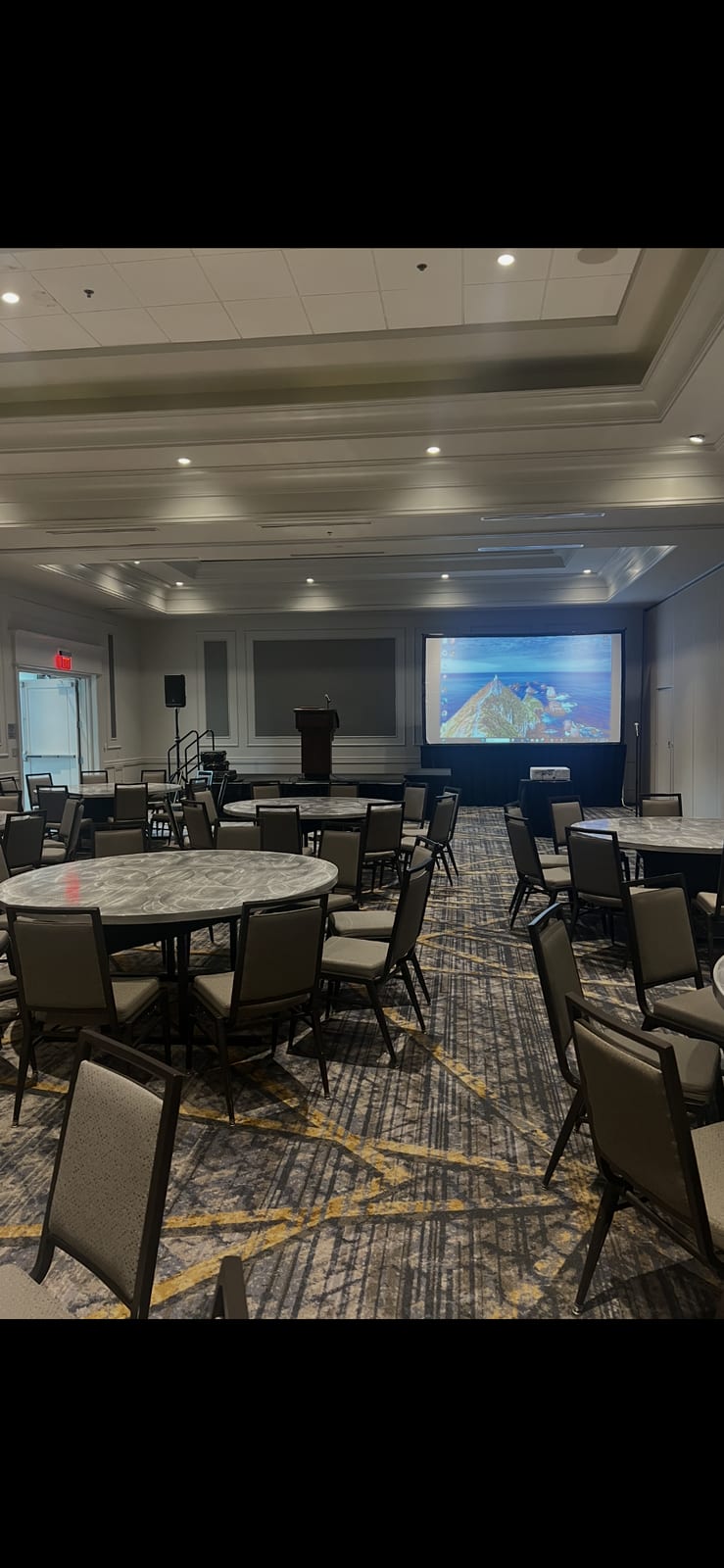
Private dining rooms were built for plates and conversation, not presentations. Ceilings are often low, there may be no blank wall, and the only power is wherever the restaurant put an outlet years ago. So before we talk about screens, I want to know four things:
How many people will be seated, and how are the tables laid out? Where will the speaker stand? Which wall, if any, is clear enough for a screen? Will servers be moving through the room during the talk?
Answer those and most of the equipment choices make themselves.
Short-throw projectors for tight rooms
A standard projector needs distance to make a big picture. In a restaurant, you usually do not have it. A short-throw projector sits close to the screen and still fills it, which means it can live on a stand near the wall instead of in the middle of the room where someone will walk into the cable.
That matters more than people expect. A projector aimed over the heads of a seated group is fine. A projector placed where guests have to duck under the beam, or where a server's tray crosses the light, is a problem. Short-throw keeps the beam short and out of the way.
A six foot screen is often the right size
Bigger is not always better in a restaurant. A six foot screen fits in most private rooms, stays readable for a table of about 40, and does not swallow the room. Past that, a bigger screen starts to block sightlines or crowd the head of the table.
If the room has a clean wall, we can project straight onto it, but a screen gives a sharper picture and holds up better in a dim, warm-lit room. I would rather bring a screen and not need it than the other way around.
Monitors on stands when a projector does not fit
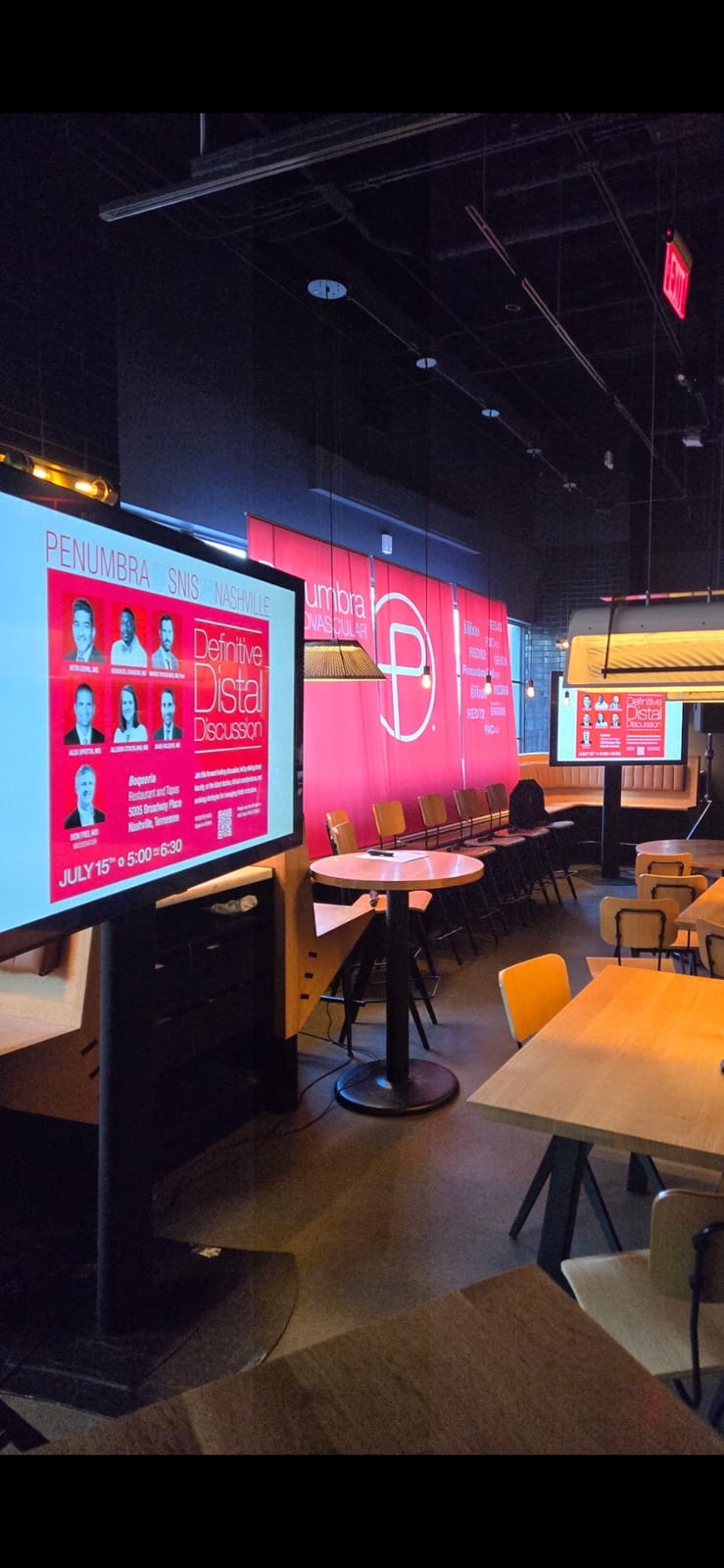
Sometimes the room says no to a projector. Maybe the ceiling is too low, or there is no spot that keeps the beam clear. That is when I bring monitors on stands, anywhere from 43 inches up to 90 inches depending on the group.
A monitor has some real advantages in a restaurant:
No beam, so nothing to walk through. A bright picture, even with the lights low for dinner. A small footprint. A stand and a cable run is easier to tuck out of sight than a projector and a screen. For a long table, two monitors on stands, one at each end, mean nobody is squinting from the far corner.
For a small board dinner of ten or twelve, one monitor at the head of the table often does the whole job.
Sound: the part people forget
Everyone plans the screen. Not everyone plans the sound. A restaurant is a noisy place even when it is quiet. Glasses clink, the kitchen door swings, and the table in the next room is having a better time than you are.
For a short talk to a small group, a podium mic is often enough. It frees the speaker from holding anything and keeps their voice at a steady level. For a presenter who likes to move around the room, a lapel mic or a wireless handheld works better. We bring a small mixer so the levels can be set once and left alone.
Here is the habit I will not skip: every mic gets tested twice. Once at the shop before it goes on the truck, and again in the room before your guests arrive. A mic that worked fine in the shop can act very differently next to a wall of glass and a ventilation hood.
Lighting the speaker
This one surprises people. Restaurants dim the lights on purpose, and that is great for dinner and bad for a presenter who needs to be seen. A little presenter lighting lets people see the speaker's face without washing out the screen. It is a small addition that makes a talk feel more professional.
Laptops, decks and the handoff
Most problems I see at a restaurant meeting happen at the connection between the speaker's laptop and the screen. The cable does not fit, the resolution is wrong, or a second presenter shows up with a different computer.
We handle source management so you do not have to. Bring your laptop, or send the deck ahead and we will load it on ours. Either way, we test the connection before your guests arrive, and we keep a backup ready. If three people are presenting, we set it up so the switch between them takes a few seconds instead of a few minutes of everyone watching someone fumble with a dongle.
What the day looks like
For a restaurant meeting, our crew arrives early, well ahead of the guests. We walk the room, check sightlines and power, and find the best place for the screen and the sound. We set up, test everything and stay on site through the event so you are not hunting for someone when the clicker stops working.
Afterward, we deal with the gear. For smaller restaurant events, we usually collect it the next day, before the restaurant opens, so nobody has to break down equipment while the last guests are still finishing coffee.
If something goes wrong during the evening, you do not call a phone tree. You call me. I answer my own phone.
A short checklist before you book
Send the room dimensions, or the name of the restaurant and the room, so we can plan around it. Tell us the headcount and how the tables will be arranged. Confirm when we can load in, and who at the restaurant will let us in. Tell us how many presenters there will be and whether anyone is joining remotely. * Send your slides ahead if you can, in a common format, with a backup copy.
That is really all it takes. A restaurant dinner does not need a big production. It needs the right small pieces, set up quietly, and a crew that stays out of the way.
Planning a dinner meeting in Nashville?
Tell me the venue, the date and roughly how many people you are expecting, and I will quote it myself.
Request a Quote, or call me at (615) 481-4887.